Designing the Architecture of Understanding

Science publishing often falls into one of two extremes: it is either dense and overly academic, or it is chaotic and oversimplified. When NEXUS approached us, they had a mandate that rejected both: “Create a modern science magazine that makes complex systems visually intuitive without sacrificing credibility.”

Built on the idea that everything is connected—from biology to astronomy—the design needed to reflect interconnected intelligence. Here is how we built a visual language for the “Curious Decoder.”

The Clarity Gap

The founders of NEXUS possessed incredible content. They covered the intricacies of the human brain, tectonic shifts, and stellar evolution. But without a unifying visual framework, these topics felt isolated.

Modern readers have short attention spans but high design expectations. If a layout doesn't guide comprehension immediately, the reader disengages. We realized that NEXUS didn’t just need to look good; it needed to function as a teaching tool. The layout had to be the teacher.

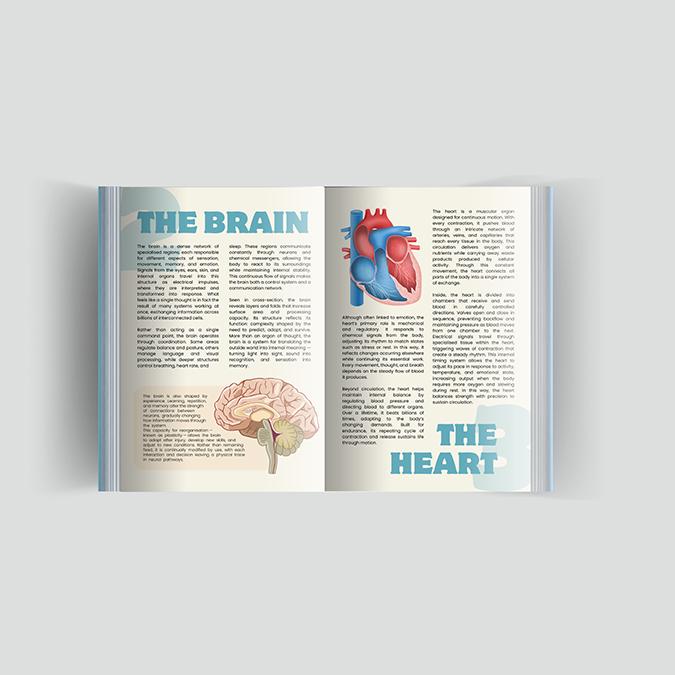
Editorial magazine spread featuring anatomical illustrations of the human brain and heart. High-contrast layout with bold typography and color-coded biological sections.
Contrast & Function
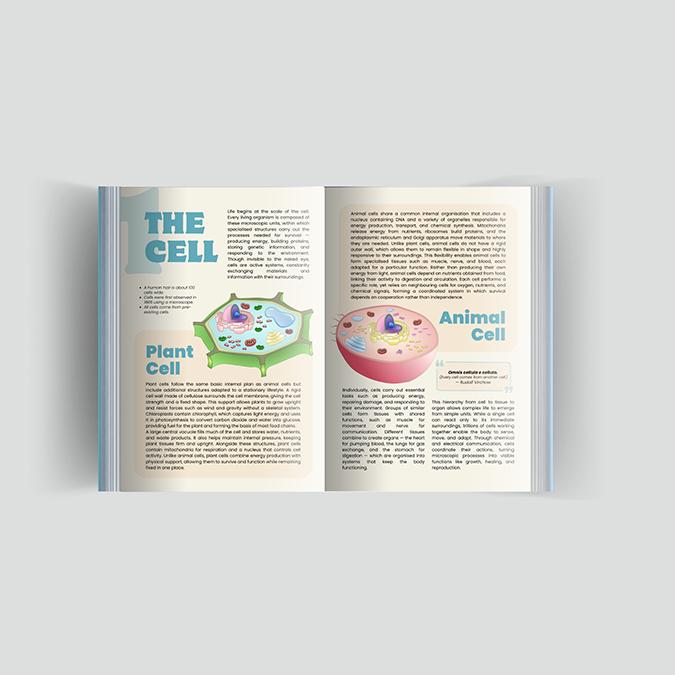
Educational infographic spread comparing Plant vs. Animal cells. 3D cross-section illustrations in a modern layout showing cell organelles and structure.
Visual Comparison

The "Curious Decoder"

We tailored the design for a specific psychographic we called The Curious Decoder. This reader values clarity over cleverness. They feel a sense of reward when a complex concept clicks into place.

To serve them, we established a core design principle: Show the structure, then explain the function.

We moved away from “wall of text” layouts. Instead, we prioritized a modular spread system where the diagram is the hero, not an afterthought.

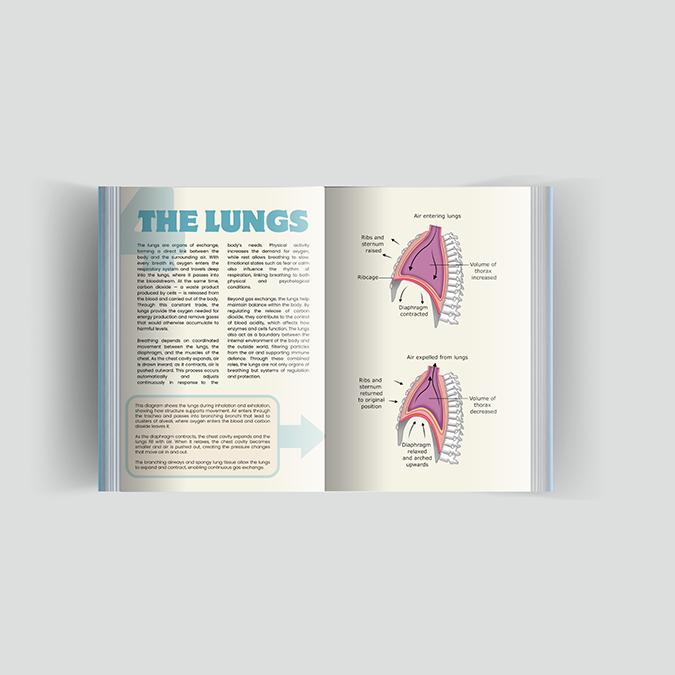
Minimalist science magazine layout detailing the respiratory system. Features step-by-step diagrams of diaphragm movement and lung expansion with clean typography.
Breathing Room
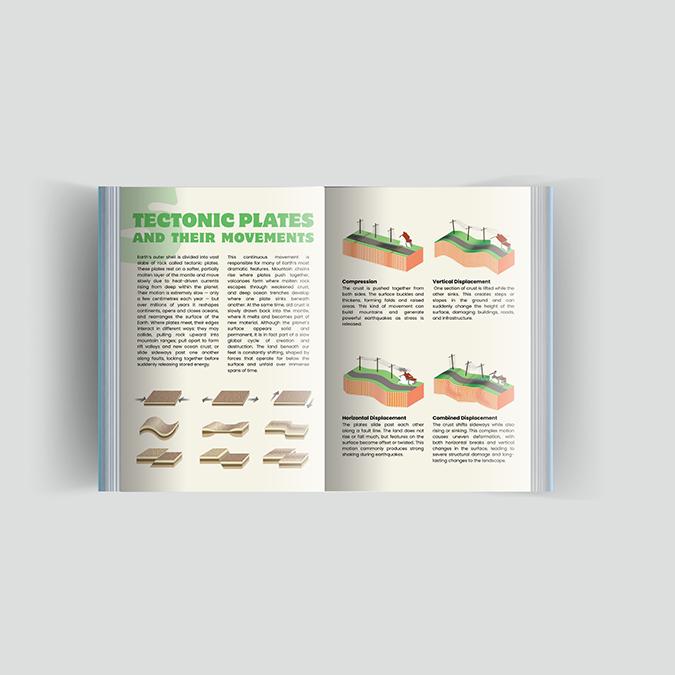
Geology magazine spread featuring isometric illustrations of tectonic plate movements. Visualizes convergent boundaries, subduction zones, and fault lines.
Isometric Clarity

Color as Navigation

To keep the magazine cohesive yet distinct, we developed "Color Universes" for different scientific disciplines. Color isn't just decoration here; it’s cognitive navigation.

  • Biology (The Lungs): Uses clean whitespace and soft anatomical tones to signal human health.
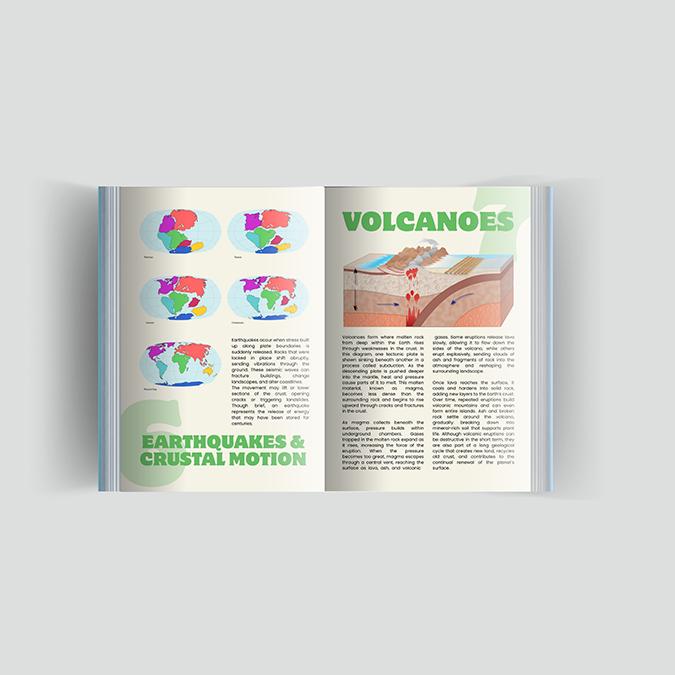
  • Earth Science (Tectonic Plates): Uses grounded earth tones, greens, and beiges.
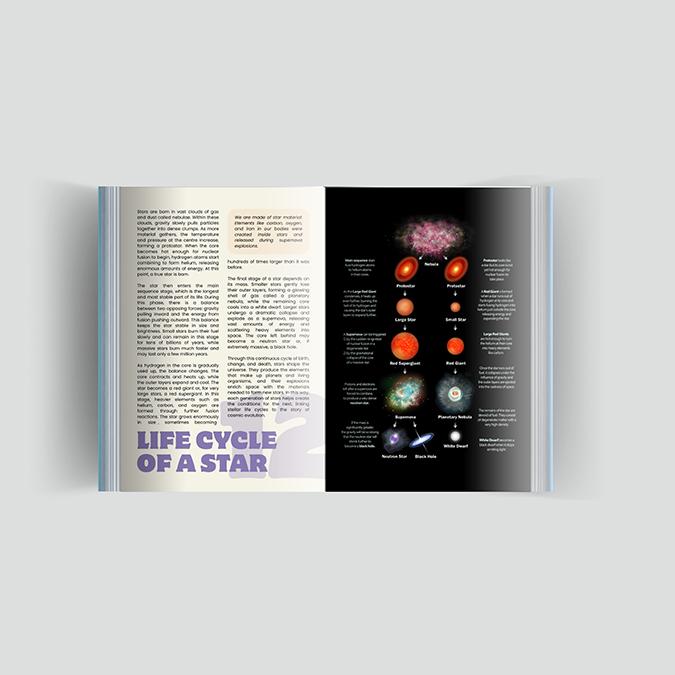
  • Astronomy (Star Cycles): Utilizes deep blacks and high-contrast neon gradients.
Astronomy magazine layout set on a black background. Infographic detailing stellar evolution from nebula to supernova and black hole with glowing neon visuals.
Cosmic Contrast
Cross-section illustration of a volcanic eruption. Geological science layout showing magma chambers, vents, and lava flow with clear typographic hierarchy.
Depth & Mechanics

Diagrams that Narrate

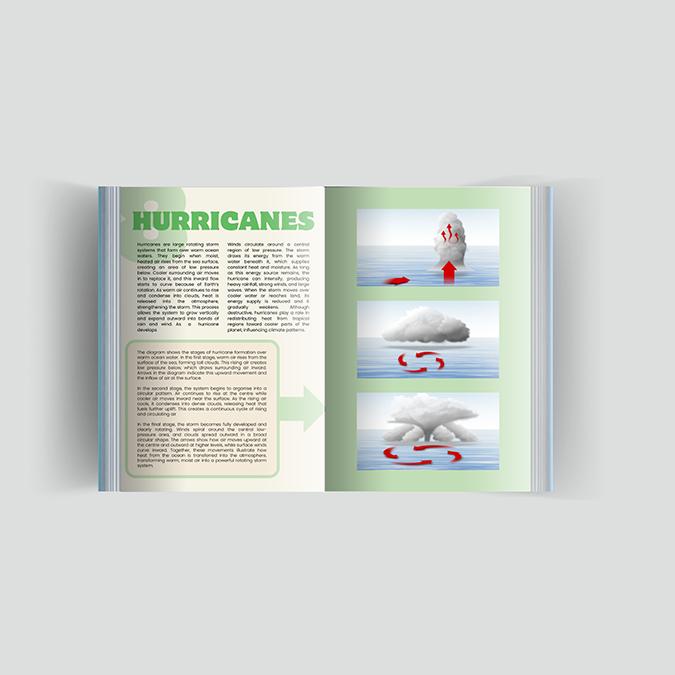
The biggest challenge was showing movement in a static medium. Whether it is the swirling formation of a hurricane or the slow grind of tectonic plates, the typography and layout had to guide the eye through time.

We utilized sequential framing and clear directional arrows to break down processes. The eye moves naturally from left to right, guided by “explanatory clusters” rather than long columns of text.

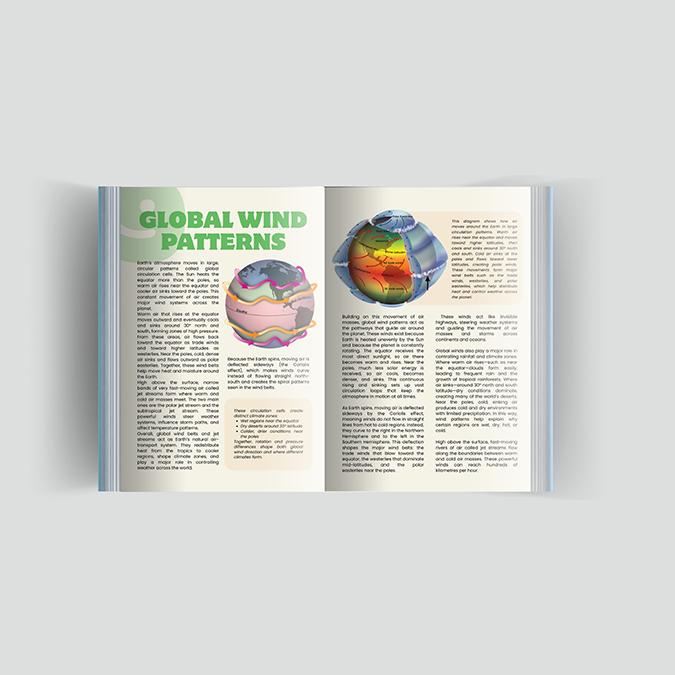
3D Globe infographic showing global wind circulation cells (Hadley, Ferrel, Polar). Editorial design utilizing curved arrows to demonstrate atmospheric movement.
Macro Visualization
Step-by-step infographic spread illustrating hurricane formation over the ocean. Vertical panel layout with directional arrows showing air moisture and heat rise.
Sequential Storytelling

The Macro and The Micro

The NEXUS system had to scale. It needed to handle the massive (global wind patterns) and the violent (volcanic eruptions) with the same level of typographic authority.

We chose a bold, geometric typeface for headlines to anchor the page, signaling stability. This allows the illustrations to be fluid and organic without the page feeling messy.

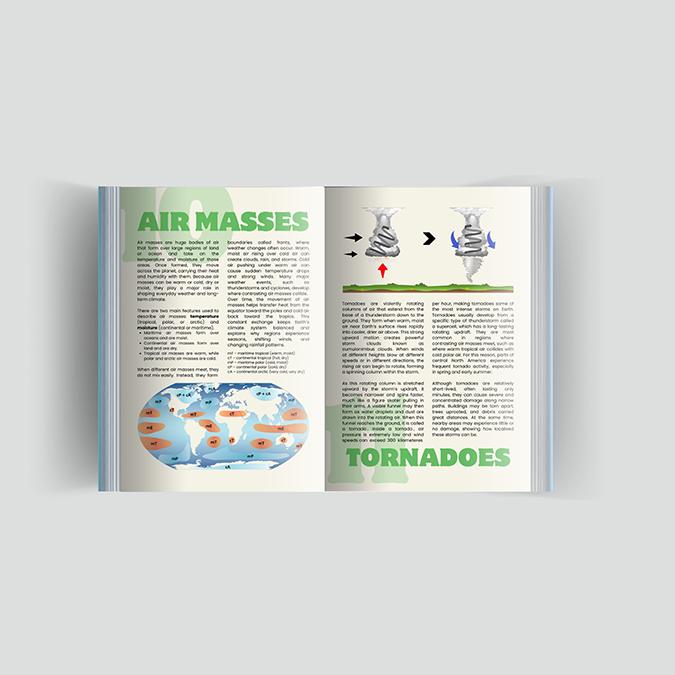
Meteorology magazine spread. Left page shows a global map of air masses; right page details the funnel formation mechanics of a tornado.
Data Hierarchy
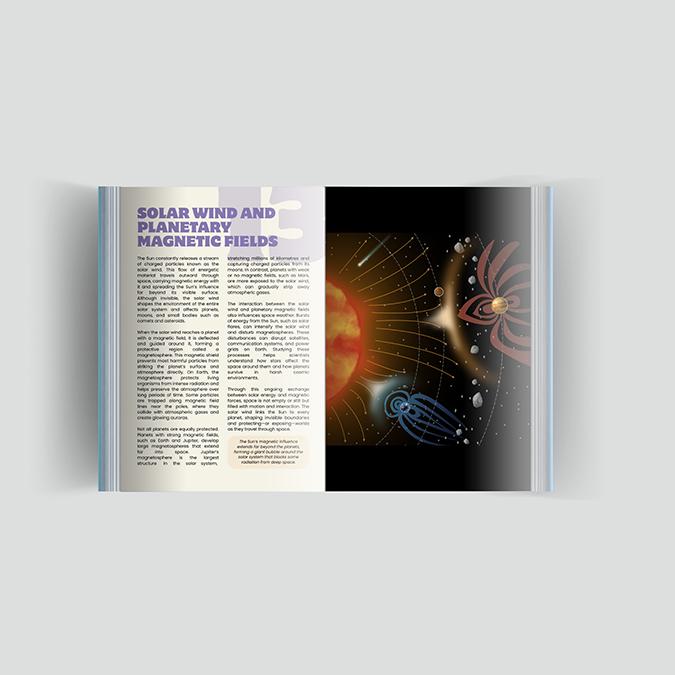
Space science illustration showing solar winds interacting with planetary magnetic fields. Dark mode editorial design with dynamic particle effects.
The Invisible Made Visible

The Outcome

NEXUS launched as a system-driven publication rather than an article-driven one. Readers now begin with the diagrams. Educators are using the spreads as visual teaching tools, and students report higher retention rates.

NEXUS finally feels like how science actually works—interconnected, structured, and alive.